Marketing Trends in 2026: Your Guide to Standing Out in a Crowded Digital Space
Struggling to stand out in a crowded digital space? You are not alone. With more content flooding our screens every second, it is getting harder than ever to make your message land — especially when you only have 8 seconds or less to grab someone's attention before they scroll past.
Every business owner I speak to is feeling the same pressure. You are working harder on your marketing than ever before. You are posting, emailing, showing up — and yet the results still do not match the effort. You are not doing anything wrong. You are just missing one thing: a clear strategy that connects everything you are doing to the right audience, in the right place, at the right time.
That is exactly what this guide is about.
In 2026, the businesses winning at marketing are not the biggest or the loudest. They are the clearest. They know who they serve, what problem they solve, and how to communicate it in a way that makes the right person stop, pay attention, and take action — in 8 seconds or less.
This guide covers the five biggest marketing trends shaping 2026, what they mean for your business, and exactly what to do about each one. Whether you are just getting started or trying to figure out why what worked two years ago is no longer working — this is for you.
Key Takeaways
- You have 8 seconds to earn your customer's attention — clarity always beats volume.
- A clear marketing strategy is the single most important investment you can make in 2026. Without it, even the best content will not convert.
- AI search is changing how your customers find answers online — and your content needs to be built to show up in those results.
- SEO in 2026 rewards genuine expertise and helpfulness, not keyword tricks. If you are genuinely good at what you do, you can win at SEO.
- Social media works best when you stop performing for the algorithm and start genuinely connecting with your ideal customer.
- Zero-click content — posts that deliver complete value without sending people off the platform — gets significantly more reach than posts with outbound links.
- Influencer marketing is one of the fastest ways to reach new customers by borrowing a trusted creator's relationship with their audience.
- Your email list is the only marketing asset you truly own. No algorithm can take it from you. Building it is non-negotiable.
Why 8 Seconds Changes Everything
Before we get into the five trends, we need to talk about attention — because everything else in 2026 starts here.
You have probably heard the statistic: humans now have an attention span of just 8 seconds. Whether or not that number is exact, what is undeniably true is this — the volume of content competing for your customer's attention has never been higher. Every business, every creator, and every algorithm is producing more content every single day. And your ideal customer has become extraordinarily good at filtering it out fast.
Research published in Psychological Bulletin (Shah and Oppenheimer, 2008) confirms what every business owner already senses: when people face information overload, the brain uses mental shortcuts to decide in seconds what is worth engaging with and what to ignore. When your marketing feels too vague, too generic, or too difficult to understand, your ideal customer filters it out before they have even consciously read it. You lose those 8 seconds before you ever had them.
But here is the empowering flip side. Research published in PLoS ONE (Engelmann et al., 2009) found that when people encounter someone they perceive as a trusted expert, the brain stops evaluating and starts trusting — dramatically shortening the decision-making process. The more consistently you show up as the go-to expert in your space, the less those 8 seconds have to do.
Your ideal customer is not ignoring you because they are distracted. They are asking one silent question every time they see your content: "Is this for me?" Content that is clear, specific, and immediately relevant to their situation gets a yes. Content that is vague, generic, or all about you gets scrolled past.
The businesses breaking through in 2026 are not shouting louder. They are speaking more clearly, to the right people, in the right places. Here is how.
Trend 1: You Need a Clear Marketing Strategy — Before Anything Else
If you have ever said "I know I should be doing more marketing but I do not know where to focus" — this is the reason.
Most business owners jump straight into tactics. Posting on Instagram. Running ads. Starting a podcast. But without a clear strategy underneath all of it, you are spending time and money creating content that never had a real chance of connecting. In 2026, with more channels and more noise than ever, strategy is not optional. It is the difference between marketing that builds your business and marketing that simply exhausts you.
You can have the most beautifully written content in the world, but if it is reaching the wrong people, on the wrong platform, with the wrong message — you will lose those 8 seconds every time.
A clear strategy means you know exactly:
- Who you are trying to reach and what they genuinely need
- What problem you solve and why you are the right person to solve it
- Which channels will reach your ideal customer most effectively
- How you will move someone from complete stranger to loyal, paying customer
The ABCD Marketing Strategy™
The ABCD Marketing Strategy™ is a framework I use with every client to cut through the overwhelm and build a clear, repeatable marketing direction.
Here is how it works:
A — Attract: Get in front of the right people.
Define your ideal customer clearly. Identify where they spend time online. Create content that answers the real questions they are already searching for.
B — Build: Earn their trust before you ask for the sale.
Show up consistently with content that demonstrates real expertise. Share case studies, results, and insights that prove you understand their world. Be present where trust is built — email, long-form content, webinars, and community.
C — Convert: Make it easy for them to say yes.
Map your entire customer journey from first awareness to final purchase. Remove every friction point. Make the next step obvious at every stage — confusion kills conversion.
D — Delight: Turn customers into advocates.
Deliver an experience that exceeds expectations. Create simple referral mechanisms so happy customers can easily share. Stay in touch through email and valuable content long after the sale.
→ Download the free ABCD Marketing Strategy Template — a step-by-step workbook to map your full marketing strategy for 2026.
Trend 2: AI Search Is Changing How Your Customers Find You
Your customers are searching differently — and if your content is not built for it, you are missing them.
Instead of typing keywords into Google and clicking through links, more and more people are asking AI tools like ChatGPT, Perplexity, and Google's AI Overviews direct questions — and getting immediate answers, without ever visiting a website. If your business is not showing up in those answers, you are invisible to a fast-growing share of your market.
The good news is that the businesses getting cited in AI answers are not the biggest ones. They are the clearest and the most genuinely helpful. That is a playing field where every business owner can compete.
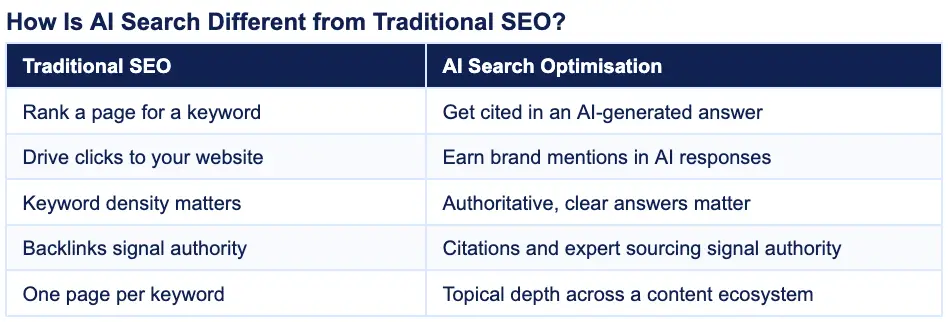
How to prepare your business for AI search:
- Lead every page with a direct, clear answer. Write your answer first, then elaborate below it.
- Use question-based headings throughout your content. AI tools match headings to the questions people actually ask.
- Cover your topic deeply across multiple pieces of content — not just a single post.
- Cite credible sources in your writing. It signals that your content is trustworthy and well-researched.
- Write in short, scannable paragraphs — two to three sentences each. This makes it much easier for AI systems to extract clean answers from your content.
- Build brand recognition consistently. When AI summarises a topic, users search for the brand they already know. Being recognised is now a ranking strategy.
Trend 3: SEO Still Works — But the Rules Have Changed
SEO is not dead. For business owners, it is more valuable than ever — but only if you understand what actually works in 2026. The era of gaming search engines with keyword tricks is over. Google in 2026 rewards businesses that are genuinely helpful, credibly authoritative, and technically sound. Get those three things right and SEO becomes your most consistent, cost-effective source of new customers — people who come to you already actively searching for what you offer.
The four things that drive SEO results in 2026:
- Topical Authority — Google rewards websites that cover a subject thoroughly and consistently. Publishing a body of interconnected content on your area of expertise signals far more authority than isolated one-off posts.
- E-E-A-T: Experience, Expertise, Authoritativeness, Trustworthiness — Publish under your real name with real credentials. Cite sources. Share insights from your own lived experience. Build a reputation that extends beyond your own website.
- Technical Performance — Page speed, mobile performance, and clean site structure are non-negotiable. If your site is slow or hard to navigate, great content will not overcome it. A simple technical audit before investing in content can save you enormous wasted effort.
- Search Intent Alignment — Every page on your website should match the intent behind the query it targets. Someone searching for advice needs an informational article. Someone ready to buy needs a product or service page. Misaligning these is one of the most common and most easily fixed SEO mistakes.
→ Read our full guide: SEO Strategy in 2026
Trend 4: Social Media Marketing — Less Performance, More Connection
Social media does not have to feel like a hamster wheel — but for most business owners right now, it does. You are posting constantly, seeing little return, and feeling like you are performing for an algorithm that keeps moving the goalposts. Here is the shift that changes everything: the business owners winning on social media in 2026 are not the ones posting the most. They are the ones who have stopped chasing the algorithm and started genuinely connecting with their ideal customers.
Less performance. More substance.
What has changed on social media in 2026:
- Organic reach has compressed on almost every major platform. You have to earn attention — it is no longer handed out freely.
- Your content now competes with the best content on the entire internet, not just other businesses in your niche.
- Authenticity consistently outperforms high production value. Your audience can sense when content is manufactured.
- Community signals — comments, shares, saves, DMs — drive algorithmic reach far more than passive impressions or follower counts.
How to build your social media strategy in 2026:
Step 1: Pick fewer platforms and go deeper.
Spreading yourself across five platforms and doing none of them well is the single biggest social media mistake business owners make. Pick the one or two platforms where your ideal customer is most active. Build a genuine presence there before expanding anywhere else.
Step 2: Share real value and your genuine perspective.
Post your actual opinions. Share real insights from your experience. Talk about what you have learned from working with clients. When you consistently show up as the expert who genuinely understands your customer's world, trust builds over time — and trust is what converts.
Step 3: Build a community, not just an audience.
An audience watches. A community participates. Ask questions. Reply to comments. Invite conversation. Engaged communities generate referrals, repeat business, and word-of-mouth that no advertising budget can replicate.
Step 4: Consistency beats volume, every time.
Three high-quality posts a week that genuinely serve your audience will always outperform daily posting that just fills a schedule. Set a sustainable cadence and protect it.
Step 5: Embrace the zero-click era — stop posting outbound links.
This is one of the most practical changes you can make right now. Most social media platforms in 2026 actively suppress posts that contain outbound links, because every click that takes a user off-platform is a user they lose. If you are regularly posting links to your website or blog in your feed, you are limiting your own reach without realising it.
The zero-click rules for 2026:
-
Write posts that are complete and valuable on their own — no click required.
-
Move your links to your bio, not the post itself.
- You can use ManyChat to send our links via direct messages.
-
Use social to build awareness and trust on-platform, then move your most engaged followers to your email list where you own the relationship.
-
Exception: if you sell products through an online store or Shopify, product links are fully expected and accepted. Instagram and TikTok have built native shopping features specifically for this.
Step 6: Use influencer marketing to reach new customers.
One of the fastest ways to grow your reach in 2026 is to borrow someone else's trust. When a creator whose audience trusts them recommends your business, their followers skip the evaluation process and move straight into consideration — that is the trust transfer at work.
You do not need a celebrity or a massive influencer to make this work. Micro-influencers — those with between 10,000 and 100,000 followers — consistently outperform larger accounts because their audiences are more engaged and their niche alignment is far tighter.
How to make influencer marketing work:
-
Prioritize relevance over reach. A smaller influencer whose audience matches your ideal customer is worth far more than a huge one with a misaligned following.
-
Give creators genuine creative freedom. Scripted content gets spotted immediately. Let them talk about your brand in their own voice — that is what makes the trust transfer work.
-
Think long-term. A single post creates awareness. An ongoing partnership creates credibility.
-
Repurpose their content in your paid ads and emails. Creator content frequently outperforms polished branded creative because it feels real.
-
Measure what matters: engagement rate, referral traffic, and conversions — not just impressions or follower counts.
Trend 5: Email Marketing — The One Channel You Actually Own
If there is one marketing investment every business owner should make in 2026, it is building their email list.
Every other channel you use — Instagram, TikTok, Google, Facebook — is rented space. The platform owns the relationship. They can change the algorithm, reduce your reach, or shut down entirely, and you have no say in any of it. Your email list is different. It is yours. Completely.
Every person on your list has actively raised their hand and said "I want to hear from you." In a world flooded with AI-generated content and paid advertising, that kind of voluntary, opted-in trust is extraordinarily valuable — and it converts at a significantly higher rate than cold social media reach.
How to use email marketing effectively in 2026:
Always lead with value.
Every email should give your subscriber something genuinely useful — an insight, a tip, a resource — before it asks for anything in return. The businesses with the best open rates are the ones whose subscribers think: "I always get something worth reading from this person."
Segment your list as it grows.
A generic blast to everyone on your list is losing effectiveness as inboxes get smarter. As your list grows, segment it by interest, behaviour, or where someone is in their journey. More relevant emails get better open rates, more clicks, and more sales.
Build these three automations before anything else.
- A welcome sequence for new subscribers.
- A nurture sequence for new leads.
- A re-engagement campaign for inactive subscribers. Done well, these three automations generate revenue around the clock without additional effort from you.
Test consistently and refine over time.
- Subject lines have the biggest single impact on open rates. Test a new approach every week.
- Send times vary by audience — experiment with morning vs evening, weekday vs weekend.
- Some audiences respond to long, personal emails. Others prefer short and direct. Test and pay attention.
- Small changes to your CTA wording can make a significant difference to click-through rates.
And if your list is small right now — do not let that stop you. A list of 200 engaged, opted-in people who genuinely trust you will generate more revenue than 10,000 social media followers who passively scroll past. Start building now. The best time was a year ago. The second best time is today.
Conclusion
You have 8 seconds. Make them count.
The marketing landscape in 2026 is noisier, more competitive, and more complex than it has ever been. But the businesses breaking through are not doing more — they are doing less, with far more intention. They have a clear strategy. They know their audience. They show up consistently with content that genuinely earns attention. And they have built the marketing assets — email lists, authority, community — that no algorithm can take away.
You do not need to master every trend in this guide at once. Start where you are. Get your strategy clear using the ABCD framework. Apply the 8-second test to everything you are currently putting out — does your ideal customer know within seconds that this is for them? Pick one channel and commit to doing it well. Build your email list.
Small, strategic steps compound. The business owners who will look back on 2026 as the year everything shifted are not the ones who did the most. They are the ones who finally got clear — on who they serve, what they offer, and how to show up for the right people, consistently.
You do not have to figure this out alone. That is what Digital Strategy League is here for.
→ Ready to build a marketing strategy that actually works? Download the free ABCD Marketing Strategy Template.
Frequently Asked Questions
I'm doing a lot of marketing but not seeing results. What am I missing?
The most common cause is doing too many tactics without a clear strategy underneath them. If your marketing is not connected to a specific audience, a specific message, and a clear path to purchase, you are creating activity without direction. The ABCD Marketing Strategy™ framework gives every channel and every piece of content a clear purpose — and helps you stop investing energy in things that are not moving your business forward.
How do I get found on Google and AI search without paying for ads?
Create content that directly and clearly answers the questions your ideal customers are already asking. Use plain language. Get to the point quickly. Cover your subject thoroughly across multiple pieces of content over time. Both Google and AI tools reward content that is genuinely helpful and easy to understand. Publishing consistently on one or two topics you know deeply is the most reliable way to build organic visibility that lasts.
Which social media platform should my business be on in 2026?
The one where your ideal customers already spend their time — not the one that feels most exciting right now. If you serve other businesses, LinkedIn and email tend to deliver the strongest return. If you sell directly to consumers, Instagram, TikTok, or Facebook may be more effective depending on your audience's age and habits. The most important thing is to pick one or two platforms, show up consistently and with genuine quality, and go deep before you go wide.
How do I know if my marketing is actually working?
Track the metrics that connect directly to revenue, not the ones that simply feel good. Follower counts and post impressions mean very little on their own. The numbers that matter are: how many new leads or enquiries you are generating each month, where those leads are coming from, how many convert into paying customers, and what it costs you to acquire each one. If you cannot confidently answer those questions right now, finding those answers is your most important next step.
I don't have time to do everything in this guide. Where should I start?
Always start with strategy. Before you post anything, run any ads, or set up any funnels, get clear on who you are trying to reach, what you are offering them, and what you want them to do next. Then pick one channel and do it with real quality and consistency. For most business owners, the highest-leverage starting point is building an email list and publishing valuable content on one platform. Everything else can be layered in once that foundation is working.
What is the ABCD Marketing Strategy™?
The ABCD Marketing Strategy™ is our four-stage framework covering the complete customer journey: Attract the right audience, Build trust and authority with them over time, Convert their interest into sales, and Delight them into becoming loyal advocates who refer others. It gives your entire marketing operation a coherent direction — so every channel, every post, and every email is working toward the same outcome.
Is email marketing still worth doing if I only have a small list?
Absolutely — and one of the most important things to understand about email is that size is far less important than quality. A list of 200 people who have opted in, who trust your expertise, and who are genuinely interested in what you offer will generate more revenue than 10,000 social media followers who passively scroll past your content. Start building now, regardless of where you are starting from. Consistent effort compounds over time.
About the Author

Jazeera Adilkhan is the founder of Digital Strategy League and a marketing coach dedicated to helping business owners turn marketing strategy into real, sustainable revenue.
Jazeera works with entrepreneurs and small business owners who are tired of guessing at their marketing and ready to build something that actually works. Her approach cuts through the noise of trends, tactics, and shiny new tools — and gets back to what has always driven business growth: knowing your audience, showing up with clarity, and building genuine trust over time.
Whether you are starting from scratch or trying to get more from the marketing you are already doing, Jazeera brings the strategy, structure, and real-world experience to help you move forward with confidence.
If this post was helpful, follow Jazeera and Digital Strategy League for weekly marketing insights, practical strategy tips, and honest conversations about what it actually takes to grow a business in 2026 on Facebook, Instagram, YouTube and LinkedIn.
Want to work together? Explore Digital Strategy League programs and resources here.
References:
Shah, A. K., & Oppenheimer, D. M. (2008). Heuristics made easy: An effort-reduction framework. Psychological Bulletin, 134(2), 207–222.
Engelmann, J. B., Capra, C. M., Noussair, C., & Berns, G. S. (2009). Expert financial advice neurobiologically "offloads" financial decision-making under risk. PLoS ONE, 4(3): e4957. https://doi.org/10.1371/journal.pone.0004957